Chemical IBC Storage Container — 20ft High Cube One-Trip (Ref 2854)
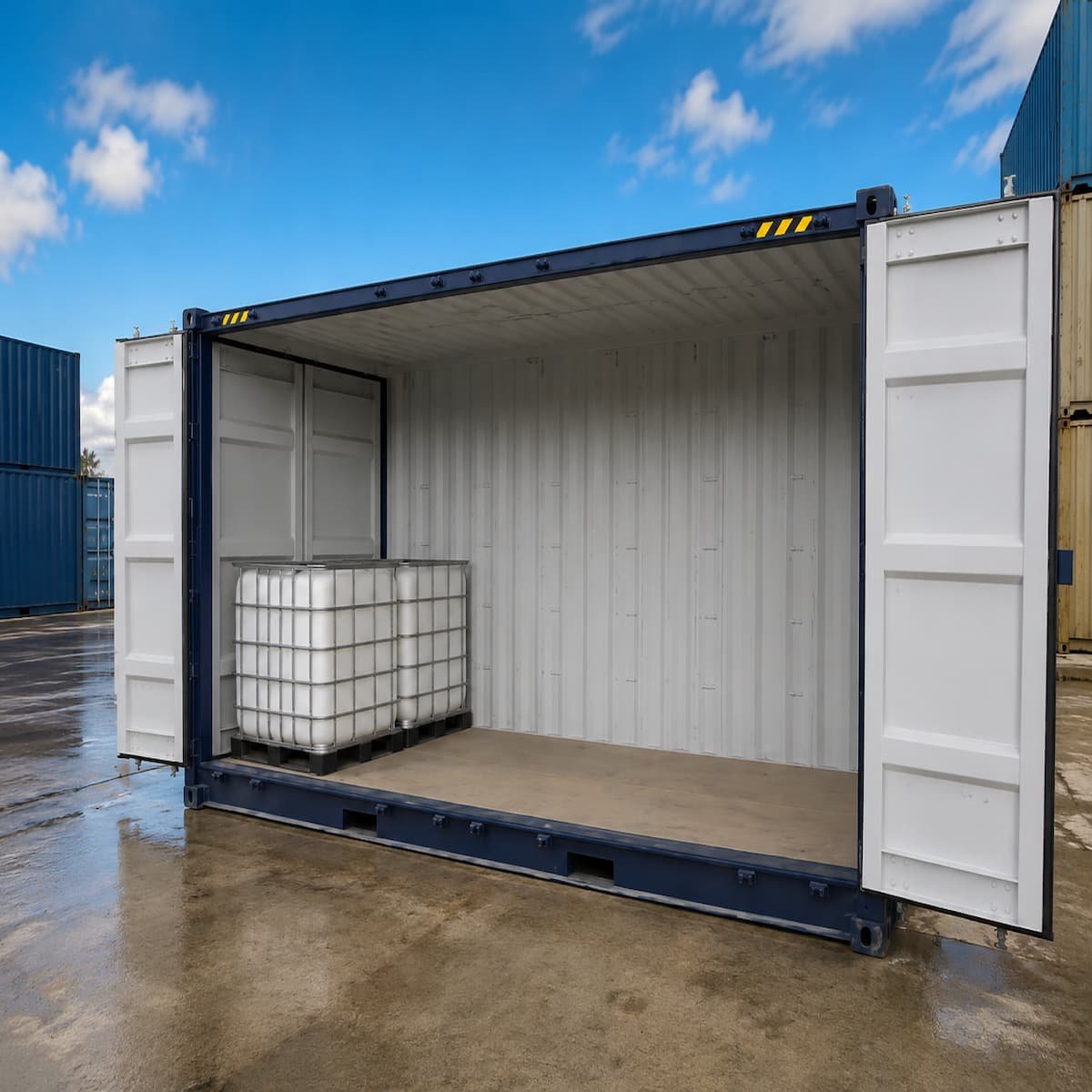
This chemical IBC storage container puts 16,000 litres of liquid storage behind lockable steel. Sixteen 1,000L IBC tanks fit inside with full top-fitting clearance, thanks to the 2,698 mm High Cube interior. Four passive vents manage vapour build-up, and full-length side doors give a forklift lateral access to every tank position. Because the unit has never carried cargo, the interior holds no residue from previous freight. Built to ISO 668 Series 1 dimensional standards.
Height — the Non-Negotiable Spec
A 1,000L IBC with valve assembly and top connections needs roughly 2,420–2,500 mm of clearance. Standard 20ft containers offer 2,385 mm — operators end up forcing doors closed against protruding fittings. The High Cube’s 2,698 mm removes the problem entirely.
Dimensions
External
| Length | 6,058 mm (20′ 0″) |
| Width | 2,438 mm (8′ 0″) |
| Height | 2,896 mm (9′ 6″) — High Cube |
Internal
| Length | 5,898 mm (19′ 4″) |
| Width | 2,352 mm (7′ 8″) |
| Height | 2,698 mm (8′ 10″) |
| Floor area | 14.86 m² (160 sq ft) |
End Door Opening
| Width | 2,340 mm (7′ 8″) |
| Height | 2,585 mm (8′ 5″) |
Specifications
| Construction | Cor-Ten weathering steel — corrosion resistant |
| Flooring | 28 mm marine plywood on steel cross members |
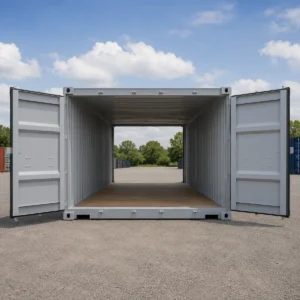
| End doors | Hinged double doors — full-width 8ft opening |
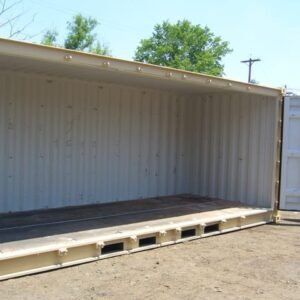
| Side doors | Hinged double doors — full-length 20ft opening |
| Locking | 2 locking bars per door, factory-fitted lockboxes on all doors |
| Ventilation | 4 passive vents — vapour and heat management |
| Forklift pockets | 2 per side — 4 total |
| IBC capacity (footprint) | 16 × 1,000L — 16,000L total (see compliance notes below) |
| CSC plate | 30,000 kg (30 tonne) max gross weight |
| Colour | Blue |
| Standard | ISO 668 Series 1 |
| Condition | One-Trip (New) — never previously loaded |
Ventilation for Vapour Management
Chemical and solvent vapours concentrate fast in sealed steel boxes. The four passive vents keep air moving through the container so vapour and heat disperse during storage. Suits liquids that must not sit in a stagnant, sealed atmosphere. Passive ventilation is not a substitute for mechanical extraction where higher-hazard classes or continuous decanting operations are involved — see compliance notes.
Security on Every Door
Factory-fitted lockboxes shield the padlocks on all doors from bolt cutters and pry bars. Two locking bars per door add a second barrier on every access point. Unauthorised access becomes a cutting job rather than a bolt-cutter job.
Dual Access for Safer Handling
The full-length side doors let a forklift reach all sixteen IBC positions laterally. No tank gets shuffled to reach another — reduced manual handling and reduced spill risk during loading. The end doors remain available for conventional access and unloading at a dock.
Typical Liquid Storage Applications
- Agricultural chemicals — herbicides, pesticides, and liquid fertilisers
- Industrial process liquids — solvents, acids, alkalis (subject to compatibility with Cor-Ten steel and marine ply — see compliance notes)
- Water treatment — chlorine solutions, pH adjusters, flocculants
- Workshops and depots — hydraulic fluids and lubricants in bulk
- Mining reagents — process chemicals at remote operations
Compliance & Site Requirements — Read Before Ordering
This container is supplied as a modified structural product — a secure, ventilated, weatherproof steel enclosure with dual forklift access. It is not supplied with spill containment (bunding), dangerous goods signage, mechanical ventilation, or fire suppression. Dangerous goods storage in Australia is regulated at state level under state Work Health & Safety and environmental protection legislation. Buyer compliance with the following is required before storing chemicals:
- Bunded spill containment — required for all flammable and combustible liquid storage. Bunded spill pallets under each IBC row, or a dedicated bunded floor, sized to hold 110% of the largest container or 25% of aggregate stored volume (whichever is greater) per AS 1940
- AS 1940 — Storage and handling of flammable and combustible liquids (primary standard for most industrial and agricultural chemicals)
- AS 3780 — Storage and handling of corrosive substances (acids, alkalis)
- AS 4326 — Storage and handling of oxidizing agents
- AS/NZS 3833 — Storage and transport of mixed classes of dangerous goods and combustible liquids in packages and IBCs
- Australian Dangerous Goods (ADG) Code — road and rail DG transport compliance for outgoing shipments
- HAZCHEM signage and placarding — DG classification, placarding, and emergency information per AS 3846 and applicable state regulations
- Safety Data Sheets (SDS) — current SDS for every stored substance, accessible on site
- Emergency response equipment — spill kits sized for stored volume, fire extinguishers, and personal protective equipment (PPE)
- DG storage licence/notification — some jurisdictions require WorkSafe / EPA registration for stored quantities above notification thresholds
- Separation distances — from property boundaries, ignition sources, and other DG classes per state DG regulations
- Fire safety — higher-hazard classes may require additional fire protection (suppression system, detection, alarm)
- Chemical compatibility — Cor-Ten weathering steel and marine plywood are not universally compatible with all chemical classes; confirm compatibility with the specific substances being stored before purchase
Buyers are responsible for confirming applicable state DG regulations, obtaining any required licences, and installing bunding, signage, ventilation, and emergency equipment appropriate to the specific dangerous goods class being stored. Consult a dangerous goods consultant or your state’s Work Health & Safety authority and Environmental Protection Agency before purchase if this is your first DG storage installation.
Bunded configurations are available — see the modified container range for bunded floor and integrated spill containment options, and container accessories for ramps, shelving, and bunded spill pallets.